Any work of art is an expression and if an expression does not draw ones’ attention then what is its purpose?
Jiddu Krishnamurti had once posed, when asked about his purpose-“What is the purpose of a flower?”. To me this question shifts the scope to a much larger canvas than the one the interviewer was prepared to handle. In a larger canvas he could convey subtler shades of that which would constitute our ordinary experience. With work an artist expands and elaborates on what one is inspired with that makes it worthwhile. Tai Chi in Chinese means “Grand” or “Ultimate”. But what is so ultimate in it to the artist that it inspires? Art inspires though in a way such that in a collective some are spontaneously inspired and to some it dawns slowly and for some others it may not dawn in their current life. Those who are inspired cannot help but convey their very inspiration through the grammar that constitutes the art and even perhaps transcending it.
In so doing they inspire others who see value in it.
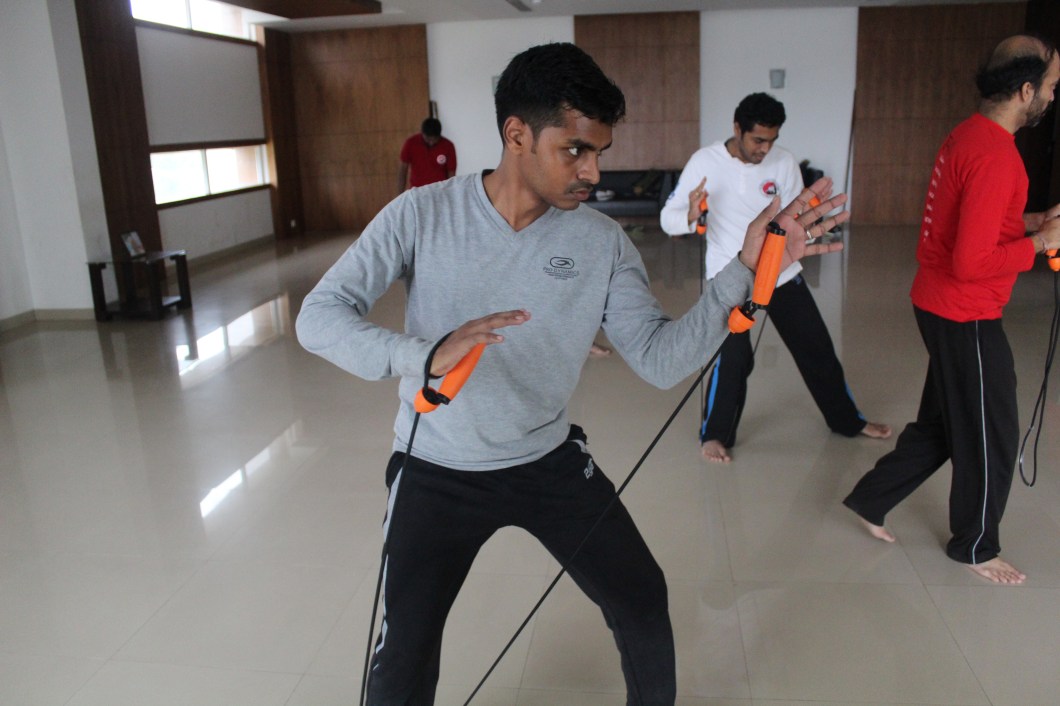
The way to effectively elaborate a Tai Chi form would be to slow it down and also, though not a popular or known approach, by speeding it up. Both reveal its mystery and the science behind it. At the same time subjecting it to repetition just so that one is relying on more of actual experience rather than on an opinion arrived at in some imagining. There is no one right speed or the number of repetition. The right speed and the number of repetitions should be that which makes the art simple and clear to the person. Terminologies can help but also they create problems and impediments when exercised by an immature practitioner. Tai Chi is not a verbal argument. One example would be that of it being a “soft martial art”. To a mature practitioner it is irrelevant whether it is soft/hard or a martial art. Not responding to every feint is softness, preempting an attack is hardness, to deal with a physical assault may be martial but diffusing a confrontation an art. Terminology used in incorrect context gives rise to confusion discerning correctly requires experience.
Personally I would support rigor but rigorous training can take one away from the spontaneity of the moment. It is a risk of being caught up in too much regimentation. Important thing is being conscious about every nuance of the form day in and day out but regimentation takes away sensitivity to feel. To the Tai Chi person a body is energy and energy is never static and is ever transforming. Observing and recording is the only constant. It should need no effort. If one is inspired to practice then that is the best frame of mind to approach ones’ practice. But every day is not a Sunday and rigor would be needed to tide over not so great times. One should come to realize how sensitive one actually is to the sound, the visuals and the scent around them. To what one reads,
speaks and to the conversations. It is easy to be lost in this sensitivity and hence just so one does not drown one needs to learn how to swim. To be a good swimmer one needs to practice well. It is going to be balancing act of rigor and spontaneity that will save the day.
There are many masters with many philosophies each only sharing their respective insights and contradictions, they go hand in hand. What do you choose? Or is one in such a position for whom it is a choice? Arising out of ones depth and gasping for ones’ breath at the surface requires trust in the art to reveal what is appropriate to the practitioner-discerning propaganda from fact and vice versa. Being patient with your instructor is necessary and essential. The instructor is also a student still improving. As long as the instructor has more insights than contradictions that person has something significant to contribute. With sufficient maturity one can tread their own course managing their own insights and contradictions. Those who discern continue treading the hard demands of the art and the science in it perennially.
Simplicity in form and movement is the inner compass for any Tai Chi practice. Building more and more capacity within so that inadvertence and carelessness have a tougher time lingering within. What one makes out of this capacity depends on
what one invests in with it. If it is invested in family, friendship and community not only there is reaffirmation of the value of the practice but one gets to unlock potentialities within all around. If this capacity were to be invested only in personal one-upmanship, manipulation and esoteric then it would prove to be a drain on sentiments of those who participate in the sham. The choice that competence bestows is not a trivial choice. With competence comes growing responsibility. As long as there is an appeal within for this you are more than welcome.
 Sattva Mushti Taijiquan
Li nice learning about Taichi art , actual experience , energy , philosophy , your insights and capacity to unlock potentials. It was indeed that energy of Taichi I witnessed 7 years ago in your 1St introductory class that has left unexplainable imprints of this responsible art .
LikeLiked by 1 person
Li forestclick and Thank you for reflecting the same energy and commitment its a blessing to find souls to share the art.
LikeLike